Product Demonstrations
Below you can find the programme for the product demonstrations that will take place during the 9th WoCoVA. This is the responsibility of the presenting company and has no relationship with WoCoVA. It will be product demonstrations or workshops organised by several companies from the vascular access industry.
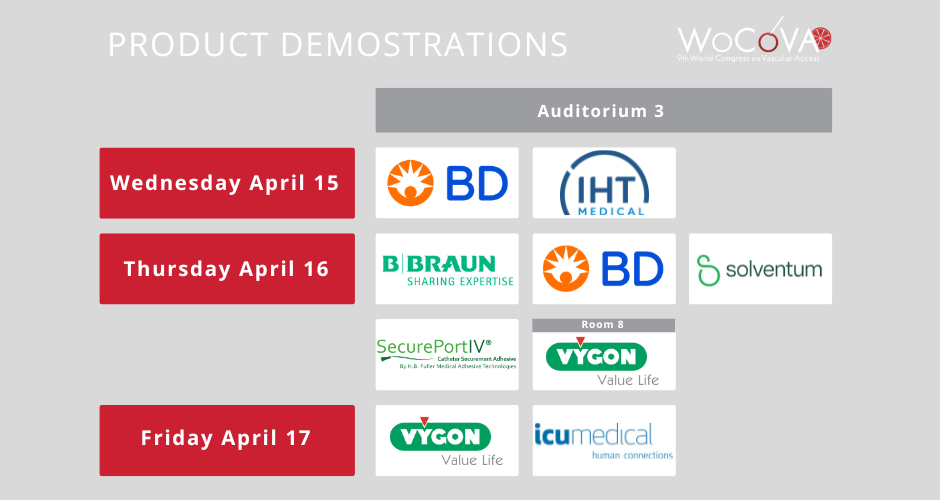
Wednesday 15 April 2026
14:15 – 15:15
Auditorium 3
Moving the needle with the latest Ultrasound Technologies
Matthew O’Brien, Associate Director of Global Medical Affairs, Advanced Access Devices
Ultrasound technology and its application for peripheral and central vascular access device placement
This session showcases how the latest ultrasound (US) technologies are helping clinicians improve vascular access device placement for both peripheral and central lines. It builds awareness of new and emerging US solutions and demonstrates how these technologies support accuracy, confidence, and first-time insertion success in clinical practice. Through a focused presentation and live demonstrations, participants will be able to envision patient-related and day-to-day benefits when implementing US guidance in device placement. The session highlights the clinical benefits and reasons to believe in solutions such as BD® SiteRite™ 9, BD® Cue™ Needle Tracking System, and BD® Sherlock 3CG+™, supported by practical insights and expert commentary. A live demo and Q&A will bring the technology to life and connect innovation directly to everyday clinical challenges.

15:30 – 16:30
Auditorium 3
360° Protection in Vascular Access: Rethinking CRBSI Prevention in Daily Practice
Fatima M’hamed, Vascular Access Team – Nurse, and Maria Staiou, Hemodialysis Supervisor Nurse
Theoretical Session
1. Building Excellence in Vascular Access:
How specialised vascular access teams improve patient outcomes and hospital efficiency
2. Preventing CRBSIs: Are We Doing Enough?:
Key challenges and opportunities in daily clinical practice
3. Antimicrobial Dressings in Focus:
Chlorhexidine dressings as a practical tool for infection prevention
4. Real-World Experience:
Integrating antimicrobial dressings into routine care: lessons learned
5. Hemodialysis Setting: A High Risk Scenario:
Role of chlorhexidine dressings in haemodialysed patients
Practical Session
Dressing application on skin simulators

Thursday 16 April 2026
08:30 – 09:30
Auditorium 3
Innovating confidence in difficult venous access with Introcan Safety® 2 Deep Access
This session introduces B. Braun´s latest innovation in peripheral IV access: Introcan Safety® 2 Deep Access, a long PIVC engineered for ultrasound-guided placement with built‑in blood control technology. Join us as we unveil a new solution created to support clinicians facing the daily challenges of difficult venous access and learn how this innovation supports safe, efficient, and confident cannulation in patients with challenging vascular anatomy.

09:45 – 10:45
Auditorium 3
Human factors at the Key-Site: Why skin prep fails and how ANTT fixes it
Stephen Rowley, Clinical Director – The ASAP/ANTT®
Skin antisepsis as the foundation of ANTT
Skin antisepsis is one of the most critical steps prior to catheter placement. Despite clear clinical intent, failures at the Key-Site continue to occur, often unnoticed, yet with significant consequences for patient safety.
The session will highlight why ANTT® matters, the burden of catheter associated with infectious complications, and common risks linked to current practices. Participants will gain practical insight into human factors influencing aseptic technique and apply ANTT principles across peripheral and central lines. The session covers Standard ANTT® for peripheral line insertion and manipulation, and Surgical ANTT® for central line insertion, manipulation, and dressing changes. Key takeaways focus on translating best practice into safer, more consistent everyday care.
12:30 – 13:30
Auditorium 3
The Science Behind Antimicrobials
Joseph Stoffel, Microbiologist at Solventum
Understanding the mechanism of action and efficacy of antimicrobials, antimicrobial resistance, and antimicrobial activity of tissue glues.

14:00 – 15:00
Auditorium 3
“Hospital-Onset Bacteremia and the Vascular Access Gap: New Risks, New Strategies” featuring SecurePortIV adhesive
Lori Kaczmarek, MSN, RN, VA-BC
“Recent proposals in the United States related to hospital-acquired infections (HAIs) now include hospital-onset bacteremia and fungemia (HOB). Application of SecurePortIV® Catheter Securement Adhesive technology at the vascular access catheter insertion site offers an evidence-based approach that establishes a protective microbial barrier, achieving a reduction exceeding 8-log in gram-negative and gram-positive bacteria, as well as yeast and fungi. Beyond its antimicrobial capabilities, SecurePortIV® contributes to catheter fixation, supports hemostasis, and improves dressing adherence. This workshop will cover SecurePortIV® Catheter Securement Adhesive, explain what Hospital-Onset Bacteremia is, and show how to use the adhesive on all types of vascular access catheters for patients of any age.”

15:00 – 16:00
Room 8 (first floor)
Rethinking Infusion Line Management: Clinical Practices. Integrating guidelines with a modern approach for a safer & standardized infusion in vascular access devices
Matthias Hellberg, Kevin Le Berre, Tiphanie Bourgeois and Leo Almerol
Infusion line practices vary widely across clinical environments, leading to inconsistent workflows, unequal levels of safety, and challenges in maintaining continuity of care. Today, the absence of shared, structured approaches to IV line organization results in significant differences from one hospital unit to another and across countries, affecting patient safety, efficiency and team coordination. This variability generates avoidable complications, increases workload for clinical teams and limits the ability to implement standardized, high‑quality infusion pathways.
In this context, there is a growing need to highlight practical, real‑world strategies that clinicians use to structure, secure and optimize IV line setups in their daily practice. This oral communication will bring together four international experts, each presenting concrete insights, operational methods and lessons learned from their own clinical environments , from pediatric cardiac intensive care to oncology and vascular access.
Through their complementary experiences, the speakers will showcase actionable approaches to improve the consistency of IV line organization, enhance patient safety, support clinical workflows and strengthen team coordination across care settings.

Friday 17 April 2026
08:30 – 09:30
Auditorium 3
The Complete Vascular Access Journey: Innovation, Safety, and Best Practices
Moderators: Fiammetta Piersigilli, Pascal Fangio, Kevin Le Berre, Leo Almerol, Christian Dupont
- Optimizing insertion of catheter: use of ultrasound for echo-guided puncture
Moderator: Fiammetta Piersigilli
Description:
This hands‑on workshop highlights the value of ultrasound‑guided puncture for all vascular access procedures. Participants will practice echo‑guided insertion on phantom models to enhance accuracy and confidence. Applicable to every insertion technique (through‑the‑needle, Seldinger, or Modified Seldinger Technique) this training supports optimal placement of PICCs, midlines, CICCs, Ports and arterial catheters from neonatal to adult patients.
- Title: Tunneling, a key practice to preserve vessel health
Moderator: Pascal Fangio (MD, Anaesthesiologist, Chief of Vascular Access Unit, Hôpitaux du Léman, Thonon-les-Bains, France)
Description:
Dr Fangio will explain to attendees the key principles of tunneling and, then, the attendees will manipulate on phantoms to improve their practice of tunneling with proximal cut PICC and PICC-Port.
- Title: Plug & Play Infusion Lines: Optimizing Line Assembly & Error recognition
Moderator: Kevin Le Berre & Leo Almerol
Description:
Safe infusion therapy depends heavily on the correct configuration, sequencing, and management of infusion lines. Misconnections, redundant components, and avoidable set‑up errors continue to be significant contributors to medication delivery issues, line occlusions, and patient harm. This interactive workshop introduces a structured, modular approach to infusion line assembly using a construction‑based educational model inspired by LEGO‑style learning. Participants will engage in guided, hands‑on exercises where infusion line components are assembled stepwise, allowing learners to visualize flow pathways, identify critical connection points, and detect potential failures in a controlled environment.
- Title: Recommended guidelines for Safe Port Care: Assessment, Maintenance and Prevention
Moderator: Christian Dupont
Description:
Revisit the essential and important steps for safe and effective port care through a practical, guideline-based workshop. You will walk through the complete care pathway from patient preparation to safe line management with a focus on the key actions that make a real difference in daily practice and strengthen patient care and safety.
- Title: Secure & Protect – Mastering Catheter Stabilization and Safe Dressing Change Management
Moderator: T.b.a.
Description:
This interactive workshop explores essential practices for catheter securement and dressing change management, two critical components in preventing complications associated with vascular access. Suboptimal stabilization, improper dressing changes, and small but avoidable handling errors remain frequent contributors to catheter dislodgement, insertion‑site infections, and therapy interruptions.
09:45 – 10:45
Auditorium 3
Preventing Occlusions Before They Start: Preserving Vascular Access in Vulnerable Populations
In many patient populations, particularly neonates and oncology patients, vascular access is not easily replaced. Preventing occlusion is not just about convenience; it’s about preserving a lifeline.
- Preventing Blood Reflux to Maintain Catheter Patency
Anti-reflux connector technology is designed to prevent retrograde blood flow into the catheter during pressure changes, helping maintain line patency and reduce thrombotic occlusion risk.
- Reducing Complications Associated with Occluded Lines
Limiting blood reflux can decrease the likelihood of clot formation, thrombolytic use, line replacements, and therapy delays, improving both patient outcomes and operational efficiency for healthcare teams.
- A Passive Mechanical Approach to a Persistent Clinical Challenge
By integrating reflux prevention directly into the connector, clinicians gain consistent protection independent of flushing technique, supporting standardized vascular access care across patients and facilities.