Industry symposia
WoCoVA 2026 is the ideal platform for presenting your latest research to VA specialists from all over the world. Industry sponsored symposia will be running in parallel with maximum 2 other industry sponsored symposia. A 45 minute sponsored symposium can only be bought if a company is a bronze, silver or gold sponsor of the 9th WoCoVA.
The industry symposia for the 9th WoCoVA are final which means that the submission for industry symposia are CLOSED. However, if your company is interested in organising an industry symposium for future editions of the congress you can contact Toine Hulshof at: [email protected].
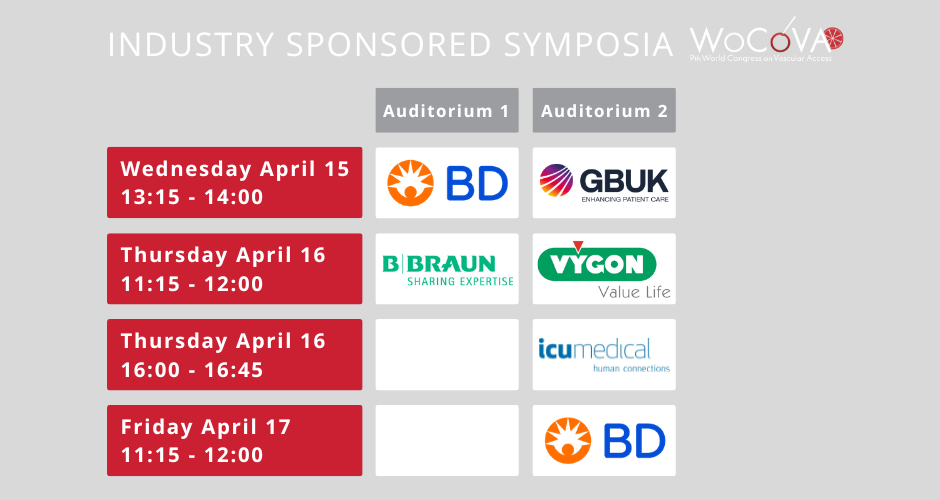
The programme and content of an industry sponsored symposium is at the sole responsibility of the presenting company.
Wednesday 15 April 2026
13:15 – 14:00
Auditorium 1

Should integrated PIVCs be the standard of care for patients?
A systematic review of the clinical and financial benefits of using an integrated PIVC
Dr Antonio Gidaro, Vascular Access Team Leader, Department of Biomedical and Clinical Sciences “Luigi Sacco, “University of Milan, Luigi Sacco Hospital, Milan, Italy.
How to include integrated cannula in your standard of care, the PVAM approach
Heather Skelland, Clinical Practice Educator, Mersey and West LancashireTeaching Hospitals NHS Trust, UK
Moderator: Stephen Church, Director Medical & Clinical Affairs, BD MDS, EMEA
Objectives:
1. Identify the design features of Integrated Short Peripheral Catheters (ISPCs) and understand how these contribute to reducing common complications such as occlusion, infiltration, dislodgement, and phlebitis in patients requiring multiday short peripheral catheterisation.
2. Interpret evidence from systematic reviews and meta-analyses regarding the clinical and financial benefits of ISPCs, including their impact on catheter failure rates and associated cost savings compared to non-integrated SPCs.
3. Evaluate strategies for optimising vascular access outcomes, including the integration of ISPCs with skin antisepsis protocols and holistic peripheral vascular access management (PVAM), to further minimise infection risk and catheter-related complications.
13:15 – 14:00
Auditorium 2

Minimising Infusion Line Complications Through Effective Hub Management and Device Selection
Effective Management of Infusion Lines for Infection Prevention
Dr Giancarlo Scoppettuolo
Key topics:
• Pre-filled syringes: Impact on infusion line complications and infection prevention
• Needle-free extension sets: Appropriate use and clinical benefits
• Stopcocks: Best practices and risk considerations
• Exit-site management: Optimising dressing selection and care
Device Selection for Safer Infusion Therapy
Gloria Ortiz Miluy
Key topics:
• Selecting the appropriate needle-free connector
• Evaluating disinfection caps and their effectiveness in reducing contamination
Moderator: Dr Mauro Pittiruti
Thursday 16 April 2026
11:15 – 12:00
Auditorium 1

Through the Clinician’s Eyes: Leveraging eye-tracking technology, hand-motion analysis, and video to evaluate a new IV catheter design
Dr. Peter J. Carr, Research Lead, Vascular Access and Infusion Therapy at University of Galway
Content of the presentation:
1. Clinical issue – Difficult IV Access and PIVC related complications
2. Current Market Environment and existing product solutions
3. Introduction new B. Braun solution Introcan Safety Deep Access XL
4. Utilisation of new technologies (Eye-Tracking) to determine ease of use and related product value
5. Importance of industry + research collaboration including utilization of competences (BBM und NUIG Galway)
6. Presentation of exe tracking research results on Introcan Safety Deep Access XL and main competitors
7. Outlook future opportunities for eye tracking technology in clinical education and product development
8. Transfer back to clinical environment: Impact of ISDA XL to hospital workflows + potential use cases for device
11:15 – 12:00
Auditorium 2

Guardians of the Vessels: Ensuring continuity of care from hospital to home
From Hospital to Home – Organizational Standards for Safe Vascular Access Continuity
Dr Elisa Deganello, Medical Dir. and VA teamcoordinator at ULSS 6, Euganea, Italy
Safe Vascular Access at Home – Practical Management, Dressing Change & Clinical Risk Reduction
Gema Muñoz‑Mozas, Lead Vascular Access Nurse – Royal Marsden, UK
Moderators:
Dr Fulvio Pinelli, IVAS President; Director, Vascular Access Center – Careggi, Italy
Dr Christian Dupont, Nurse Coordinator – Cochin Hospital; GIFAV Board, France
There is a growing and unmet need to establish consistent and structured protocols for vascular access management across both hospital and home‑care settings. Today, the quality and safety of care vary significantly depending on the country and region, as well as local regulations and the availability of trained professionals, leading to inconsistent practices in the transition from hospital to home thus creating inequality in outcomes and exposing patients to higher risks compared with hospital‑based management. The absence of clear, shared guidelines increases complications, while forcing patients to return frequently to the hospital, adding discomfort and reducing quality of life. At the same time, healthcare systems face staff shortages, uneven territorial expertise and insufficiently structured Vascular Access Teams, creating challenges in ensuring safe and continuous care pathways. This symposium will explore the need to harmonize practices and strengthen coordination between hospital-based and home‑care environments to support high‑quality, equitable vascular access management.
16:00 – 16:45
Auditorium 2

Aligning Vascular Access Practices to prevent bloodstream infections
DJ Shannon, MPH, CIC, VA-BC, AL-CIP, FAPIC
Objectives:
• Review current Standards and Guidelines as they pertain to device selection, site selection, and maintenance practices
• Highlight the importance of incorporating WHO and APIC guidance to ensure infection prevention alignment
• Emphasize the role of a multimodal approach to decreasing bloodstream infections
Description:
When it comes to decreasing bloodstream infections, you can’t just rely on one set of standards. You have to look at the big picture. That means incorporating WHO and APIC guidance along with INS and AVA. Learn more about the importance of a multimodal approach at “Aligning Vascular Access Practices to Prevent Bloodstream Infections,” presented by vascular access expert DJ Shannon. It’s one more way we help put precision into practice.
Friday 17 April 2026
11:15 – 12:00
Auditorium 2
Why should my hospital invest in VAT (Vascular Access Team)? Building a strong case to convince your hospital management
Strategic Alignment of Vascular Access Teams to Hospital priorities: Demonstrating Value and Impact.
Michela Canobbio, Health Economics and Outcomes Research Leader, EMEA, BD.
A practical example of demonstrating the impact & value of VAT.
Andrew Barton, Nurse Consultant IV Therapy and Vascular Access, Frimley NHS Foundation Trust, UK
Moderator:
Servane Pellé Lombardy, Associate Director Medical & Clinical Affairs, BD MDS, EMEA
Objectives:
1. Explain the importance of developing a comprehensive business case to establish an effective Vascular Access Team (VAT) and how it must align with the hospital’s overarching strategic priorities.
2. Deliver clear, practical, and actionable guidance on the steps, methodology, and key considerations involved in creating a strong VAT business case.
3. Demonstrate, through a real world example, how a thoroughly constructed VAT business case can drive both the creation and future expansion of the service.